









separador.png
Search

Global Maritime

CMIT welcomes MSC’s largest container vessel call ever in Vietnam

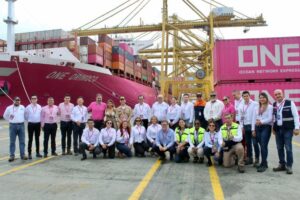
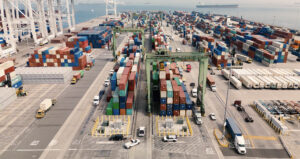
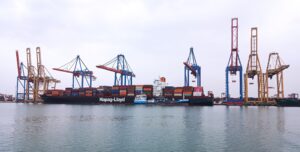
Source: APM Terminals Cai Mep International Terminal (CMIT) – APM Terminal’s joint venture with Vietnam Maritime Corporation and Saigon Port – continues to earn the trust of one of the world’s biggest shipping lines. MSC chose CMIT to handle the m/v MSC DITTE on September 24, 2022. The MSC DITTE is MSC’s largest ever container vessel to call in Vietnam. At 200,148 DWT, MSC DITTE is well within CMIT’s 214,000 DWT capacity. Reduced Port Stay The mega container vessel is operated on 2M Alliance’s Pearl service, connecting Vietnam with the US West Coast. With an average crane productivity of nearly 32 containers/hour/crane and 23-row outreach, CMIT successfully handled almost 16,000 TEUs of import, export, transshipment and empty containers, keeping her journey timely after only 54 hours’ port stay. World class capability Increasing calls for CMIT to handle mega ships such as the MSC DITTE affirm its world class capability, management and coordination with, among others, authority agencies, Ministry of Transport, Vinamarine, Vung Tau Port Authority, Pilot, and Tugboat. Special port cluster The CMIT deep-water port is categorised as a special port cluster according to the master plan of Vietnam’s seaport system 2021-2030. The vision to 2050 was approved by the Prime

Leer más »
Fairway deepening to support larger vessels and volumes at APM Terminals Gothenburg

To support growing volumes at APM Terminals Gothenburg and the port’s full potential, work is now underway to deepen the fairway. Once completed in 2026, the terminal will be able to receive the world’s largest container vessels and higher volumes. Source: APM Terminals Volumes passing through APM Terminals Gothenburg are steadily increasing, a trend that has been further accelerated by supply chain disruptions over recent years. One key driver is that APM Terminals is the only container terminal in Sweden that is equipped to handle ocean-going direct vessels to and from other parts of the world without transhipment. This greatly reduces transport time, risk and environmental impact. APM Terminals Gothenburg is equipped to accommodate vessels up to 24,000 TEU, but in order to utilise this potential and support larger volumes,  a deeper fairway is needed. “If we are to meet the increased demand from Swedish industry for the long term, we need adequate infrastructure. Our customers should not be limited by insufficient fairway depth, which is why I am pleased to announce that work to deepen the channel is planned to start in mid-November,” says Dennis Lenthe Olesen, Managing Director at APM Terminals Nordic. APM Terminals Gothenburg will work in collaboration

Leer más »
Last diesel vehicles to disappear: battery power for CTA tractor units

Source: Port of Hamburg The electrification of HHLA Container Terminal Altenwerder (CTA) is entering its final round. In the future, the tractor units deployed on the journeys between block storage and the container rail terminal or the empty depot will be driven by battery power. In order to further reduce CO₂ emissions at CTA, seven new battery-powered tractor units have been ordered and will replace the previously used equipment that runs on diesel. This terminal process will therefore emit no CO₂, nitrogen oxide or particulate matter in the future. During the course of its expected life cycle, the new electrified equipment will save nearly 3,000 tonnes of CO₂ compared with the diesel machines. Operations at CTA have already been climate-neutral since 2019, and were just recertified by TÜV Nord this year. “We have been testing a battery-powered tractor unit in operation at CTA since 2021. The vehicle has proven to be successful in tests conducted in regular operations,” reports Finja Below from CTA Terminal Development. As a result of the positive experience, seven additional tractor units were ordered and a corresponding charging infrastructure is currently being established. The tractor units supplement the container gantry cranes as well as the rail

Leer más »
Marking 50 years of protecting the oceans from dumping

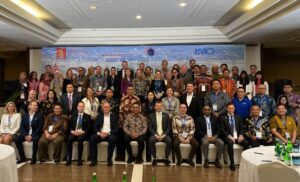
IMO is marking five decades of the London Convention, adopted in 1972 to protect the oceans from dumping of wastes. The Convention was updated in 1996 by the London Protocol, a comprehensive stand-alone global agreement,  however the two treaties work in conjunction to regulate the dumping of wastes at sea.  The London Convention and Protocol (LC and LP treaties) have evolved over the years, banning the dumping of radioactive waste at sea since the 1980s and, in the 21st century, addressing carbon capture and storage and marine geoengineering. (Learn more here) During an event to celebrate five decades since the London Convention was adopted, (3 October), IMO Secretary-General Kitack Lim highlighted the London Convention and Protocol’s “key roles over the last five decades in the governance of our ocean, located in the interface between land-based and sea-based activities”. (Read full speech here)  Following the United Nations Conference on the Human Environment (June 1972, Stockholm), the London Convention was adopted on 13 November 1972 at the Intergovernmental Conference on the Convention on the Dumping of Wastes at Sea, held in London, United Kingdom. “The international community recognized that we have a collective responsibility to protect the environment and to, in particular, address the

Leer más »
The VCFI index records a 3.2% drop in the cost of Mediterranean freight in September

Export freight rates from Valencia fell in one month in all the areas analysed, except for East Africa The decrease in the Western Mediterranean (-10.26%) and the Far East (-1.34%) stands out The Valencia Containerised Freight Index (VCFI) has reached 4,762.46 points, accumulating a growth of 376.25% since the beginning of the series in 2018 The macroeconomic scenario notes a slowdown in economic activity worldwide. Port traffic has fallen in Northern Europe (-6.1%) and Southern Europe (-2%) Source: Valenciaport The Valencia Containerised Freight Index (VCFI) for the month of September drops by 3.2% the cost of Mediterranean freight, in a year marked by the ups and downs of the Index which is conditioned by the uncertainty marked by the geopolitical situation and world trade. This is the third month in 2022 that it has fallen, especially in some areas such as the Western Mediterranean (-10.26%). In the year-to-date, the VCFI, an index based on the export prices recorded by the Port of Valencia in 13 geographical areas around the world, has stood at 4,762.46 points, accumulating since the beginning of the series in 2018 a growth of 376.25%. The macroeconomic scenario, marked by high levels of inflation, interest rate hikes

Leer más »
Colombia: Dimar fortalece acciones para el transporte fluvial con Autoridades de Brasil, Ecuador y Perú

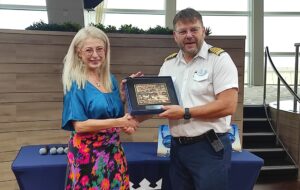
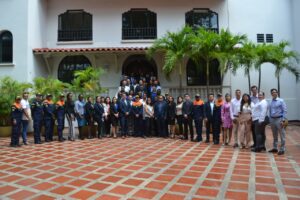
Fuente: Dimar Con el fin de fortalecer los mecanismos de cooperación para abordar las problemáticas relacionadas con el transporte transfronterizo, fomentar el intercambio de información y buenas prácticas para la creación de un marco regional sólido para el transporte fluvial internacional, la Dirección General Marítima (Dimar) lideró la III Reunión Trifronteriza con los Capitanes de Puerto de Puerto Leguízamo, El Carmen (Ecuador) e Iquitos (Perú), además de la XIII Reunión Tripartita de Capitanes de Puerto de Leticia (Colombia), Tabatinga (Brasil), e Iquitos (Perú). En el marco de estos encuentros que dirigió el Director General Marítimo, Vicealmirante John Fabio Giraldo Gallo, se asumieron compromisos para el intercambio de información, la regulación de embarcaciones, control de zarpes y arribos, además del desarrollo de ejercicios conjuntos para ejercer control del tráfico fluvial y prevenir la contaminación en los ríos fronterizos. Asimismo, esta responsabilidad fue celebrada por el Capitán de Navío André Gustavo Silveira, Agregado Naval de Brasil en Colombia; el Capitán de Navío Fabián Miño Pazmiño, Agregado Naval del Ecuador en Colombia; y el Capitán de Navío Edgar Moreno Cedamanos, Agregado Naval del Perú en Colombia, quienes destacaron el rol de las Autoridades Fluviales en la unión de los países a través de

Leer más »
Hapag-Lloyd AG acquires terminal business of SM SAAM S.A.

Source: Hapag-Lloyd Acquires stake in 10 terminals in six countries Presence in Latin America and terminal business further strengthened New company to operate as independent entity Hapag-Lloyd AG and SM SAAM S.A. signed a binding agreement today under which Hapag-Lloyd will acquire 100 % of the shares of SAAM Ports S.A. and SAAM Logistics S.A. and thereby the entire company’s terminal business and associated logistics services. The contracting parties agreed upon a price of around USD 1 billion, which also includes real estate assets related to the logistics business. Chile-based SM SAAM is a terminal operator, logistics company and towage provider active in multiple countries in the Americas. It was founded in 1960 and has been listed on the Santiago Stock Exchange (SSE) since 2012. SM SAAM’s terminal business participations comprise 10 terminals in six North, Central and South American countries with around 4,000 employees and a combined container throughput of around 3.5 million TEU in 2021. The related logistics services complement the terminal business at five locations in Chile, with together around 300 employees. SM SAAM’s tugboat services and airport logistics services businesses are not part of the transaction and will remain with SM SAAM. “Investing in terminal infrastructure

Leer más »
Cargo Integrity Group of Seven Updates its Container Safety Guidance

 Source: FIATA FIATA International Federation of Freight Forwarders Associations, together with the six other CIG Group members today shares of the update of the CTU Code. The need for increased integrity in the global supply chain persists. The Cargo Integrity Group has updated its Quick Guide to the CTU Code and once more urges all involved in intermodal container transport to pay heed. The multi-faceted group of originally five, now seven industry organisations, produced a Quick Guide to the IMO/ILO/UNECE Code of Practice for Packing of Cargo Transport Units (CTU Code) some two years ago. The Quick Guide is designed to assist those responsible for packing containers and accurately declaring details of their contents to abide by the often-complex regulations contained in the voluminous CTU Code itself. There is also a useful Checklist of actions required by packers and shippers of containers.  The Group believes that awareness of the CTU Code is pivotal to achieving safe and secure transport and has followed up the Quick Guide’s publication with provision of its full text in Arabic, Chinese, English, French, Russian, Spanish and Italian. An update has now been made available, taking account of feedback, and is downloadable for free HERE. FIATA Director General Stéphane

Leer más »
Containerships increases frequency between Germany and England

Containerships, a subsidiary of the container shipping company CMA CGM, is integrating Hamburg into its liner service BALT1. Source: Port of Hamburg The intra-European liner service “BALT-1” started in Hamburg on Friday (22/09/23) with the departure of the vessel “Containerships VIII”. The new service is designed to increase the frequency of sailings between the ports of Hamburg, Rotterdam and Teesport and to provide a direct and fast connection between Germany and the UK. Containerships announced the direct service between Germany and the UK, marketed as “DUKE”, connecting mainland Europe and the Eastern coast of the UK. Together with the extensive rail network in Europe offering daily train connections, this service is an ideal and sustainable route for the transport of goods to the UK. The “DUKE” service is thus part of the “BALT-1” liner service, which rotates between the ports of Hamburg, Rotterdam, Teesport, Rotterdam, Helsinki, Tallinn, Hamburg. According to the industry service Alphaliner, the company uses its freighters “CONTAINERSHIPS VIII” with a capacity of 850 standard containers (TEU) and the “CONTAINERSHIPS VI” with a capacity of 956 TEU. Containerships connects Hamburg not only with the UK but also with Spain and the Canary Islands, Northern Africa as well as

Leer más »
El Port de Barcelona incorpora un nuevo sistema de radares para mejorar la seguridad del tráfico marítimo

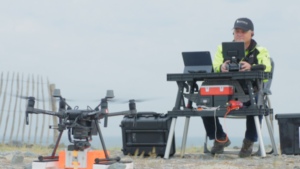
Fuente: Port de Barcelona El Port de Barcelona ha puesto en servicio un nuevo sistema de radares para la vigilancia y el control del tráfico marítimo con el objetivo de incrementar la seguridad de las operaciones a través del seguimiento, instantáneo y preciso, de los movimientos de los barcos en el exterior y al interior del puerto. El nuevo sistema está formado por dos radares instalados en la Torre de Control, situada en el muelle de la Energia, y en el muelle de Llevant, ubicaciones que ofrecen una visión completa de las aguas del Port de Barcelona. Los nuevos radares utilizan tecnología de última generación, con amplificadores de estado sólido construidos mediante semiconductores, que permite ampliar la banda de transmisión de los pulsos radar utilizando al mismo tiempo una menor potencia de las emisiones electromagnéticas. Esta tecnología alarga la vida de los equipos y mejora la calidad de las imágenes. El sistema permite a los operadores de tráfico portuario detectar las embarcaciones que no disponen de sistema AYS (Sistema de Identificación Automática), obteniendo una visión más precisa e instantánea de la ubicación de cada nave y, por lo tanto, incrementando notablemente la seguridad marítima en el puerto. Esta visión precisa

Leer más »