













separador.png
Search

Global Maritime

4 key trends for wind energy businesses in 2023

Source: MAERSK Currently battling the aftermath of a global pandemic, the increasing cost of energy, a cyclical unavailability of raw materials, and a high level of inflation, the wind energy industry is struggling, but not losing power. When looking into the forecasted performance for the sector, Grand View Research states that “the global wind power market size was valued at “99.28 billion USD in 2021 and is expected to expand at a compound annual growth rate (CAGR) of 6.5% from 2022 to 2030”. This confirms that wind power, onshore and offshore, has tremendous potential for greater future development. When looking into the data, the challenge seems to be that what is normal today wasn’t normal two years ago for this industry, which is characterized by constant change, fast innovation, and unpredictable politics. While the sector is seeing a contraction in Europe (with Germany pledging for a rapid expansion), the amount of electricity generated by the wind sector globally increased by almost 273 terawatt hours (TWh) in 2021 (up 17%), a growth higher than all other power generation technologies. The biggest contribution was brought in by China, responsible for almost 70% of wind generation growth in 2021, followed by the United States at 14% (where the sector supported over
Leer más »
Intermodal transport connections ensure low environmental impact

Source: Port of Hamburg Sweden and Germany are two highly developed industrialised countries with long-standing economic relations based on strong foreign trade. Germany is one of Sweden’s most important trading partners and this relationship is also reflected in the large number of connections between the German and Swedish North Sea and Baltic Sea ports. The Port of Lübeck, for example, handled almost nine million tonnes of cargo with Sweden last year. In Hamburg, 292,000 TEUs crossed the quays. At the event “Intermodal transport connections – an answer to climate change” in Trelleborg, which was organized by Lübecker Hafen-Gesellschaft mbH (LHG), the Port of Trelleborg, and Port of Hamburg Marketing reg. Assoc. (HHM), experts discussed ways to make the connections even more environmentally friendly. Marina Basso Michael, Regional Director Europe at HHM, and Håkan Nilsson, Director Industry at the Swedish Freight Forwarders’ Association, chaired the event and began by emphasising the need for joint action by all parties involved in the transport chain. “Against the background of high CO2 emissions, it is important to drive the systemic change towards climate neutrality,” stressed Basso Michael in her welcome speech. The panel discussion was then moderated by Håkan Nilsson, Director Industry at the

Leer más »
El Port de Barcelona instala placas fotovoltaicas innovadoras en el muelle de Pescadors e inicia su primera comunidad energética

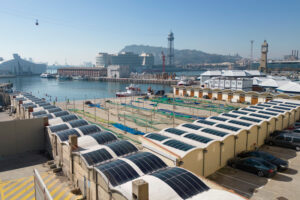
Fuente: Port de Barcelona El Port de Barcelona, COMSA Corporación y la Cofradía de Pescadores de Barcelona han trabajado conjuntamente en la instalación de placas fotovoltaicas flexibles en las cubiertas de las casetas situadas en el muelle de Pescadors. La actuación se enmarca dentro del proyecto europeo LIFE BIPV (Building-integrated Photovoltaics), coordinado por COMSA Corporación y cofinanciado por el programa europeo LIFE. El objetivo del proyecto es desarrollar y demostrar soluciones innovadoras para integrar módulos fotovoltaicos en los edificios y aumentar así la generación de energía renovable y la sostenibilidad de edificios e infraestructuras. La instalación fotovoltaica sobre las casetas tiene una potencia de 29,5 kWp y se estima que anualmente generará 43,4 MWh, es decir, el 5% del consumo total del muelle de Pescadors y un 11% del consumo de la fábrica de hielo. Las innovadoras placas fotovoltaicas, desarrolladas por el fabricante alemán Heliatek, han sido producidas con materiales orgánicos y son muy ligeras y flexibles y se adaptan a la ondulación de las cubiertas de las casetas sin estructuras de apoyo adicionales, optimizando así la integración del sistema en el entorno y reduciendo costes en materiales e instalación. Estas casetas disponen de unas cubiertas con vuelta de medio

Leer más »
Pioneering a clean ship future

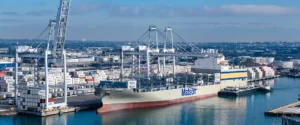
Source: Port of Long Beach PORT TAKES AGGRESSIVE, INNOVATIVE APPROACHES ON COURSE TO ZERO-EMISSIONS OPERATIONS When “K” Line’s Long Beach Bridge arrived at the Port of Long Beach in 2008, it was more than just another ship call. Outwardly, the operations involved in berthing the container ship would have seemed routine: a pilot boarded outside of the breakwater to guide the vessel to the International Transportation Service terminal at Pier G. Mooring operations secured the behemoth vessel to land, allowing ship-to-shore cranes to begin plucking containers. A weather eye might have noticed dockworkers dragging a long cable to the Long Beach Bridge, connecting it into a container-like box on the ship’s side. Soon after, the ship switched off its auxiliary engines, which were normally used to power vital systems. But the systems – lighting, pumps, computers, air conditioning – churned on. The Long Beach Bridge became the first ship at the Port to plug into shoreside electrical power, eliminating the need to burn diesel fuel to “keep the lights on” during its stay and preventing the accompanying emissions from escaping into the harbor air. Today, container ships at all of California’s major ports use shore power, thanks to technology developed at

Leer más »
Colombia: Dimar anuncia mejoras en el canal de acceso a la zona portuaria de Barranquilla

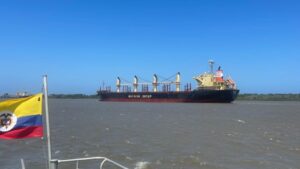
Fuente: Dimar La Dirección General Marítima (Dimar), informa el mejoramiento en las condiciones de calado para las embarcaciones que arriban y zarpan de la zona portuaria de Barranquilla, con un calado que asciende a 9.7 metros. De acuerdo con la Capitanía de Puerto de Barranquilla, los análisis realizados por la alta dinámica en el tránsito de embarcaciones, sedimentación, cambios en los niveles del río Magdalena en temporada seca y labores de dragado, se establecen los siguientes parámetros: BUQUES ESLORAS (metros) CALADOS(metros) CONDICIONES DE OPERACIÓN OBSERVACIONES  Hasta 200 Hasta 9.7 Sin restricción ·      30 centímetros de asiento positivo mínimo.·      Dentro de límites océano-atmosféricos para ejecución demaniobras. Se analizará la maniobrabilidad de cada embarcación que se encuentre sobre los límites máximos permitidos y se notificará sobre los avances en el sector, de acuerdo con las intervenciones y afectaciones que se presenten, además de los resultados del pronóstico de los vientos de la época; La Autoridad Marítima continuará monitoreando la evolución de las condiciones de navegabilidad con personal profesional especializado, pilotos prácticos e información hidrográfica disponible. Este calado estará vigente hasta una próxima actualización; cualquier cambio o restricción que se presente, se informará para adoptar las medidas necesarias, garantizando la seguridad integral marítima y fluvial del país.

Leer más »
Shell and Hapag-Lloyd collaborate on marine fuel decarbonisation and sign multi-year LNG supply agreement

Source: Hapag Lloyd Shell Western LNG B.V (Shell) and Hapag-Lloyd today announced the signing of a multi-year agreement for the supply of liquefied natural gas (LNG) to Hapag-Lloyd’s ultra large dual-fuel container vessels of 23,500+ twenty-foot equivalent units (TEU). Bunkering for these twelve new vessels is expected to commence during the second half of 2023 and LNG will be supplied in the Port of Rotterdam. The modern ships will be deployed on Europe-Far East routes and call at major ports including Rotterdam, Hamburg, Singapore, and Shanghai. Using LNG enables Hapag-Lloyd to immediately reduce the CO2 intensity of these vessels by up to 23% compared to conventional fuels (1). Additionally, the use of LNG supports the almost complete reduction of particle emissions (2). This is another important step for Hapag-Lloyd to reduce emissions and decarbonise its fleet in line with its goal of becoming net zero carbon by 2045. As a hard-to-abate sector, Shell is exploring the viability of, and investing in a range of fuels, technologies and solutions that will help decarbonise shipping. This includes the use of LNG, where through an extensive network of 15 LNG bunkering locations in 10 countries globally, Shell has already achieved over 1,000 safe

Leer más »
El sector turismo en el Caribe crece de manera acelerada y desvincula su crecimiento de su impacto ambiental: WTTC

WTTC anuncia impacto ambiental del sector turismo en el Caribe por primera vez El sector representó el 17.8% del total de emisiones a nivel regional por esta actividad en 2021, un 8% por debajo de las emisiones registradas en 2019El Caribe fue la segunda región con mayor avance en la recuperación de su sector turístico Fuente: WTTC Santo Domingo, República Dominicana: El Consejo Mundial de Viajes y Turismo (WTTC, por sus siglas en inglés), y el Centro Global de Turismo Sostenible, con sede en Arabia Saudita, han revelado nueva información detallando la huella de carbono en el sector de Viajes y Turismo en el Caribe. Entre 2010 y 2019, el sector de Viajes y Turismo de la región desvinculó su crecimiento económico de las emisiones de gases de efecto invernadero. Los datos de la organización muestran que, durante este periodo, mientras que la contribución de los viajes y el turismo al PIB del Caribe creció un promedio del 3%, los gases de efecto invernadero aumentaron solo en un 1.4%. Según el informe de Impacto Económico de WTTC, el Caribe, la región más dependiente del turismo a nivel mundial, logró una recuperación de casi el 37% en su contribución al PIB en 2021,

Leer más »
New service highlights potential of Poti as Central Asia-Europe intermodal hub

This month saw the first call of CMA CGM’s new Caucasus Georgia Express (CGX) service. Playing a key role in this new intermodal service, APM Terminals Poti works as a hub for cargo consolidation and dispatch, connecting trains directly from the Middle Corridor to Georgia, for onward maritime transport to and from Greece and Turkey. Source: APM Terminals The new CGX maritime service transports cargo from APM Terminals Poti to Piraeus, Greece and Ambarli Port in Istanbul, Turkey within three and seven days respectively. The service makes approximately three roundtrips a month. The APM Terminals Poti hub connects regular trains, from China – via either Kazakhstan or Turkmenistan, Uzbekistan, and Kyrgyzstan – to this new maritime service to reach Turkey. According to CMA CGM, transit via Poti to Armenia and Azerbaijan takes between five to six days. Via Poti to Kazakhstan 35 days, Turkmenistan 25 days, Kyrgyzstan and Tajikistan 45 days and Uzbekistan approximately 50 days, based on Caspian Sea vessel availability. APM Terminals’ new intermodal hub connecting Central Asia and the Caucasus region is now operational, providing an alternative to traditional routes currently blocked by Russian sanctions. Gateway to Central Asia Commenting on Poti and the Black Sea’s status

Leer más »
Port of Rotterdam throughput virtually unchanged in 2022 despite war and weakening economy

The war in Ukraine led to unprecedented changes in goods flows last year. At 467.4 million tonnes, total throughput in Rotterdam was almost the same (-0.3%) as in 2021 (468.7 million tonnes) but the underlying figures show that there were major changes. Source: Port of Rotterdam Container throughput fell by 5.5% in TEU (-9.6% in tonnes), mainly because container traffic to and from Russia came to a virtual standstill after the invasion of Ukraine. Imports of LNG, mainly from the USA, increased by 63.9% as an alternative to Russian gas. At the same time, coal imports rose by 17.9% as mainly German coal-fired power plants were used more. In line with the sanctions, companies reduced imports of Russian oil, oil products and coal, and succeeded in importing them from elsewhere.   Allard Castelein, CEO of the Port of Rotterdam Authority: “2022 was an extraordinary year in many ways. The war and the sanctions led to changes in energy flows around the world and high energy prices, and therefore high inflation and the weakening of the economy. The Rotterdam business sector and all service providers were able to respond quickly and effectively. The war has also demonstrated the risks for crucial sectors

Leer más »
Liquid and solid bulks in January continue the upward trend of recent months

Fuente: Valenciaport Valenciaport, as a thermometer of the import/export activity of its hinterland and the international economic situation, has begun the year 2023 with an increase in liquid and solid bulk traffic and a fall in goods per container. According to data from the Statistical Bulletin of the Port Authority of Valencia (PAV), the first month of the year shows an increase of 13.8% in liquid bulk compared to January 2022 and 21.4% in solid bulk. In the accumulated 2022, liquid bulks ended with an increase of 50.4% and solid bulks of 4.45%. Regarding non-containerised goods, growth was 3.28%, while goods and products arriving by container fell by 24%. This means that, in January of this year, 5,715,093 tonnes of goods were handled, which represents a drop of 15.95% compared to the same month in 2022. The Port of Valencia, which specialises in containers, is experiencing a fall in the number of containers, as is the case in other major European ports at the start of the year. Thus, a total of 343,793 TEU (standard 20-foot container) have been mobilised, representing a decrease of 23.57%. Of these, the full containers have suffered a drop of 25%, especially the decrease of

Leer más »